






If you’re a writer who creates stories or film scripts, but you’re just starting out and dream of seeing your story turned into a movie, you may be wondering where to send it and who to approach. In this article, you’ll learn “How to Pitch Your Bollywood Script” the right way.
You probably have many questions in mind. Should you send your script directly to a producer? Should you email a big production house? Or should you send it to a director on WhatsApp?
Before taking any step, it’s important to think carefully.
Almost every new writer goes through this confusion. The truth is, writing a film script (story and screenplay) is only the first step.
The next step is even more important—how to present your script professionally and reach the right person. In the film industry, this process is known as script pitching.
In this article, you’ll learn how to pitch your script in Bollywood and what precautions you should take to ensure your story doesn’t end up in the wrong hands.
What Is Script Pitching?
Many new writers don’t fully understand what script pitching actually means. They assume it simply means sending their story directly to a producer or director. In reality, that approach is completely wrong.
Pitching a script means presenting your story in a way that sparks the other person’s interest. After all, why should someone choose to read your story instead of hundreds of others?
Producers and directors receive many scripts every week. So why would they spend their time reading yours? That’s why you need to be very careful before pitching your story.
Unless your story offers something unique, you’re unlikely to receive a response. That’s why it’s not just your story that matters—your preparation and your professional approach are equally important.
🎬 Want to write better dialogue?
If you’re writing a screenplay for a movie, web series, or short film, Writing Dialogue for Scripts can be a valuable resource. The book offers practical guidance on writing engaging dialogue, giving each character a unique voice, and making conversations feel natural.
If you want to improve your screenwriting skills, it’s definitely worth checking out.
👉 Buy Link: Writing Dialogue for Scripts
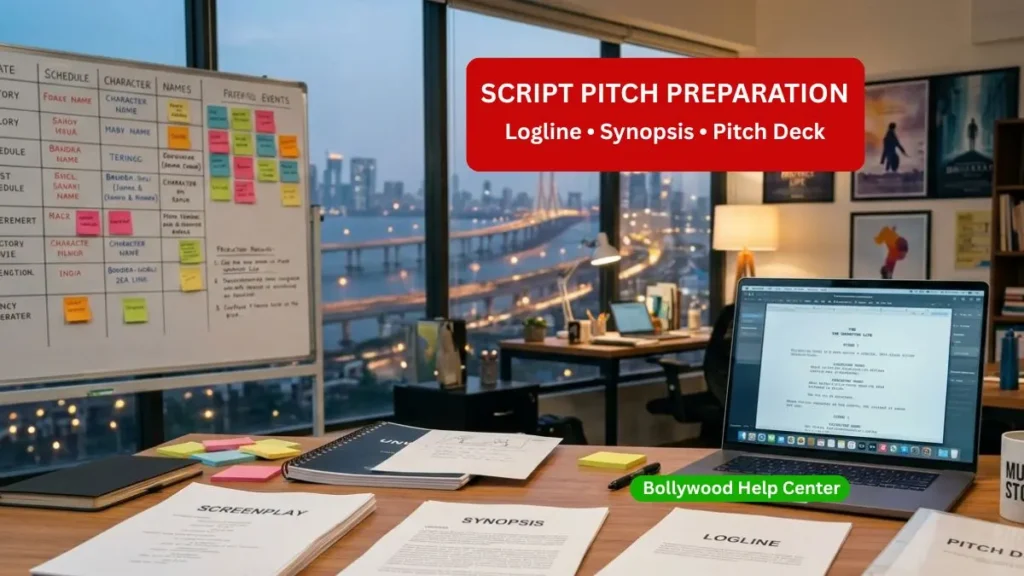
Preparation Before Pitching Your Story (Very Important Step)
You should never send your story directly to a producer or director. That would be a mistake.
Before pitching your script, you should have these four things ready:
- Logline – A logline is a brief summary of your story in two to four lines. It should clearly present the core idea of your film. It’s also known as a one-line story.
- Synopsis – A synopsis explains the complete story of your film in one or two pages. It should cover the beginning, the middle, how the story progresses, and the climax—without hiding any important plot points or suspense.
- Pitch Deck – A pitch deck, also called a story bible, is an attractive PDF presentation that includes character sketches, the tone of the story, and visual references. Its purpose is to help the reader understand your project clearly.
- Bound Script – This is the complete screenplay containing every scene in proper screenplay format.
You should prepare all four of these before approaching anyone with your script. This is what makes you look like a professional writer. Your preparation and the way you pitch your story can have a significant impact on the response you receive.
This is the professional way to submit a script.
However, always remember one important thing: before sharing your script with anyone, make sure you register it with the Screenwriters Association (SWA).
Should You Send Your Script Immediately After Finishing It?
Never rush to send your script as soon as it’s finished. Before submitting it, take some time to review it carefully.
Read your story at least once or twice and ask yourself a few important questions:
- Does the story flow smoothly without confusing the reader?
- Have all the characters been properly established?
- Is the purpose of the story clear?
- Do the dialogues sound natural?
- Is the story becoming unnecessarily long?
Take these points seriously. If you notice any weaknesses, spend more time improving your script.
Remember, the first draft you send is often the one that creates your first impression. A well-prepared script can open the door to better opportunities.
Want to write stronger screenplays? Save the Cat! Writes a Screenplay is a practical guide that helps you master story structure, memorable characters, and scenes that keep audiences engaged. A great resource for aspiring screenwriters.
👉 Buy Link: Save the Cat! Writes a Screenplay
Where and How Should You Pitch Your Story?
In Bollywood, you usually can’t approach producers or directors directly. You need to follow the right professional path.
1. Creative Producers and Development Executives
Almost every major production house—whether it’s Dharma Productions, Yash Raj Films, or others—has a creative team. Their job is to discover new stories, evaluate scripts, and filter promising projects.
Instead of trying to reach the producer directly, you should approach these creative professionals.
2. Literary Agencies
Just like Hollywood, Bollywood also has literary agencies that represent writers.
Agencies such as Tulsea, Matrix, and Collective Artists Network work with screenwriters and help connect them with producers and production houses.
If an agency decides to represent you, it becomes their responsibility to introduce your script to the right people in the industry.
3. Chief Assistant Directors (Chief ADs) and Script Supervisors
Assistant directors working with well-known filmmakers are always looking for strong and interesting stories.
If they like your script, they may introduce you directly to the director, which can create valuable opportunities for you.

How Should You Approach Them?
Today, instead of visiting production offices and trying to narrate your script in person, it’s much better to build a professional digital network.
1. Through a Professional Email
Visit the official website of the production house or search on LinkedIn to find the email address of the creative team.
Write a professional email introducing yourself and include your Logline.
Instead of attaching your entire script immediately, politely ask if they would be interested in reading your synopsis.
2. Through Social Media
Follow creative professionals on LinkedIn and Instagram.
If appropriate, send a short, polite, and professional pitch introducing your story. Keep your message brief and respectful.
3. Attend Industry Events
Participate in film festivals such as MAMI, IFFI, and events organized by the Screenwriters Association (SWA).
These events give you excellent opportunities to build professional relationships within the film industry.
What Should You Include in Your Email?
Whenever you send a script pitch email, make sure it includes:
- A brief introduction about yourself
- Script title
- Film genre
- A strong logline
What Should You Do If You Don’t Receive a Reply?
If you don’t receive a response after sending your email, don’t get discouraged.
There could be several reasons:
- The recipient may be busy.
- They may not be looking for that type of story at the moment.
- You may not have followed the company’s script submission policy.
- Your email may not have reached them.
If you don’t hear back, send one polite follow-up email.
You can simply mention that you had sent a script pitch earlier and wanted to check whether they had a chance to review it.
However, avoid sending repeated emails or continuously contacting people through social media or phone calls. Doing so may create a negative impression.
Always remember that not receiving a response to your first script does not mean your journey is over. If you continue improving your writing and keep following a professional approach, the right opportunity can come at the right time.
Pitch to the Right Person
Many new writers believe that sending their script to as many producers as possible will increase their chances of success.
In reality, that’s not the right approach.
For example, if you’ve written a family drama set in a small town but send it to a producer who mainly makes horror or action films, your script is unlikely to attract interest.
That’s why it’s important to research the people you’re approaching before pitching your story.
Pitching your script to ten random producers is far less effective than sending it to the one producer whose work matches your story.
My Personal Experience
Along with being an editor, I am also a writer, and a couple of films have been made based on my scripts. That’s why I’d like to share my personal experience with you. The process I explained above is the professional way to pitch a script. However, the industry doesn’t always work in just one way.
Sometimes, if you already know a producer personally and they like your synopsis, they may decide to move forward with your project.
Another common method is pitching through email. As I mentioned earlier, if you follow the proper format and maintain a professional approach, you improve your chances of getting noticed. One thing I always recommend is this: never send your script to anyone without thinking carefully.
Never Send Your Script on WhatsApp
If you’ve written a good story, never send your story, synopsis, or screenplay through WhatsApp.
Whenever you need to share your work, always use email.
If you’d like to learn more about the Screenwriters Association (SWA), understand the membership process, or learn the basics of script registration, be sure to read our detailed guide.
According to SWA guidelines, email serves as valid evidence. Even if your script hasn’t been registered, an email record may still help establish proof if a dispute arises.
However, if you send your script through WhatsApp and someone later uses your story without permission, protecting your rights can become much more difficult.
I also want to give you one more piece of advice.
Whenever you complete a story, screenplay, or dialogue script, try to register it with the Screenwriters Association (SWA). It provides an additional layer of protection for your creative work.
If someone makes a film based on your story without your permission or without giving you proper credit, SWA can take appropriate action and help you protect your rights, including seeking proper credit and compensation where applicable.
That’s why I strongly recommend registering your work.
You can register both online and offline. I’ve also created a video explaining how to register your songs and stories online.
If you’d like to watch the video, visit the Bollywood Help Center YouTube channel. You can also complete the registration process by visiting the SWA office in person.
Conclusion
If you’re truly passionate about becoming a writer in Bollywood, remember that writing a good story alone is not enough.
The better your story is, the more important it becomes to present it professionally.
Learning How to Pitch Your Bollywood Script, whom to contact, whom to avoid, and how to prepare a strong logline and synopsis are all essential skills.
These are the things that help you grow as a professional writer and significantly improve your chances of getting opportunities in the film industry.
If you have any questions or suggestions related to this article, feel free to message us on Instagram.
You can also let us know which topic you’d like us to cover next.
I hope this guide on How to Pitch Your Script in Bollywood was helpful.
If you found this article useful, please share it with other aspiring writers and subscribe to Bollywood Help Center for more career guides, filmmaking insights, and Bollywood knowledge.
Disclaimer
This article is published for general educational and informational purposes only.
Script submission, pitching, and registration processes may vary depending on the producer, production house, agency, or organization.
Before sharing your script or any creative work, always verify the official submission policies and guidelines of the organization you are approaching.
Affiliate Disclaimer– Some links in this article may be affiliate links. If you purchase a product through those links, we may earn a small commission at no additional cost to you.
Your support helps Bollywood Help Center continue creating valuable and informative content for aspiring filmmakers and writers. For more Bollywood career tips, visit our YouTube channel (Hindi). Bollywood Help Center
About Bollywood Help Center
Bollywood Help Center publishes practical guides about Bollywood careers, filmmaking, and the Indian film industry. Follow us on Instagram and subscribe to our Hindi YouTube channel for more updates.
Thanks –